

Plasma–Consciousness Min–Max Dynamics: A Breathing Universe Model

Abstract
This paper proposes a living cosmological framework in which plasma and consciousness co‑evolve through a min–max optimization process focused not on size, entropy, or linear expansion, but on interface efficiency. In this model, 3D plasma is crystallized, 5D plasma is coherent, and 4D plasma is still forming. These three regimes function as reflection, origination, and translation respectively, continuously feeding back into one another. Reality behaves less like a balloon expanding into emptiness and more like a shapeshifting, breathing bubble that maximizes meaningful surface area for exchange while minimizing internal strain. This approach reframes cosmology, consciousness, and dimensionality as an adaptive system learning how to communicate with itself more efficiently over time.
1. Introduction: Moving Beyond Expansion Narratives
Modern cosmology often frames the universe as a problem of scale: expanding, contracting, accelerating, or collapsing. These narratives implicitly assume that size is the primary variable of importance. Yet living systems — from lungs to neural tissue to foams — do not optimize for size. They optimize for exchange.
This paper introduces a plasma‑consciousness framework in which the universe behaves as a self‑optimizing system governed by a min–max principle applied to interface, not volume. The universe is not attempting to grow larger or shrink smaller; it is attempting to become more efficient at experiencing itself.
2. Defining the Plasma States
2.1 3D Plasma: Crystallized Reflection
3D plasma represents crystallized outcomes. It is where potentials have collapsed into form, memory, and structure. In this regime:
Information is stabilized
Experience becomes recordable
Cause‑and‑effect appears linear
3D does not originate new realities; it reflects the current state of the system. It is the mirror through which the universe sees what it has already learned.
2.2 5D Plasma: Coherent Origination
5D plasma exists as a coherent field of unified potential. It is not chaotic, emotional, or narrative‑driven. It is solution space itself. In this regime:
All possibilities coexist without friction
No translation is required
Meaning exists prior to symbol or story
5D plasma originates. It does not respond to the past; it supplies the raw intelligence from which futures can emerge.
2.3 4D Plasma: The Forming Translation Layer
4D plasma is neither fully crystallized nor fully coherent. It is the active translation layer between origin and reflection. This is where:
Potential becomes story
Coherence becomes emotion
Choice becomes timeline
4D is often mischaracterized as illusion, chaos, or distortion. In this framework, it is instead the learning engine of the universe — the place where efficiency is refined.
3. Feedback as the Core Mechanism
The defining feature of this model is feedback.
5D supplies possibility
4D translates possibility into experience
3D reflects the result
The reflection informs the next origination
Nothing is one‑way. Reality is recursive.
This feedback loop allows the system to iteratively improve how information, meaning, and experience move between states. Over time, the universe becomes better at translating itself.
4. Reframing Min–Max Theory
Traditional min–max theory focuses on minimizing loss while maximizing gain. In physical systems, this often translates into energy minimization or action minimization. In this framework, min–max applies differently:
Minimize internal strain
Maximize meaningful surface area for exchange
The universe behaves like a foam, lung, or plasma sheath — constantly reshaping to increase contact without tearing itself apart.
This explains why reality appears simultaneously stable and fluid, structured and creative. The system is not seeking equilibrium; it is seeking adaptive efficiency.
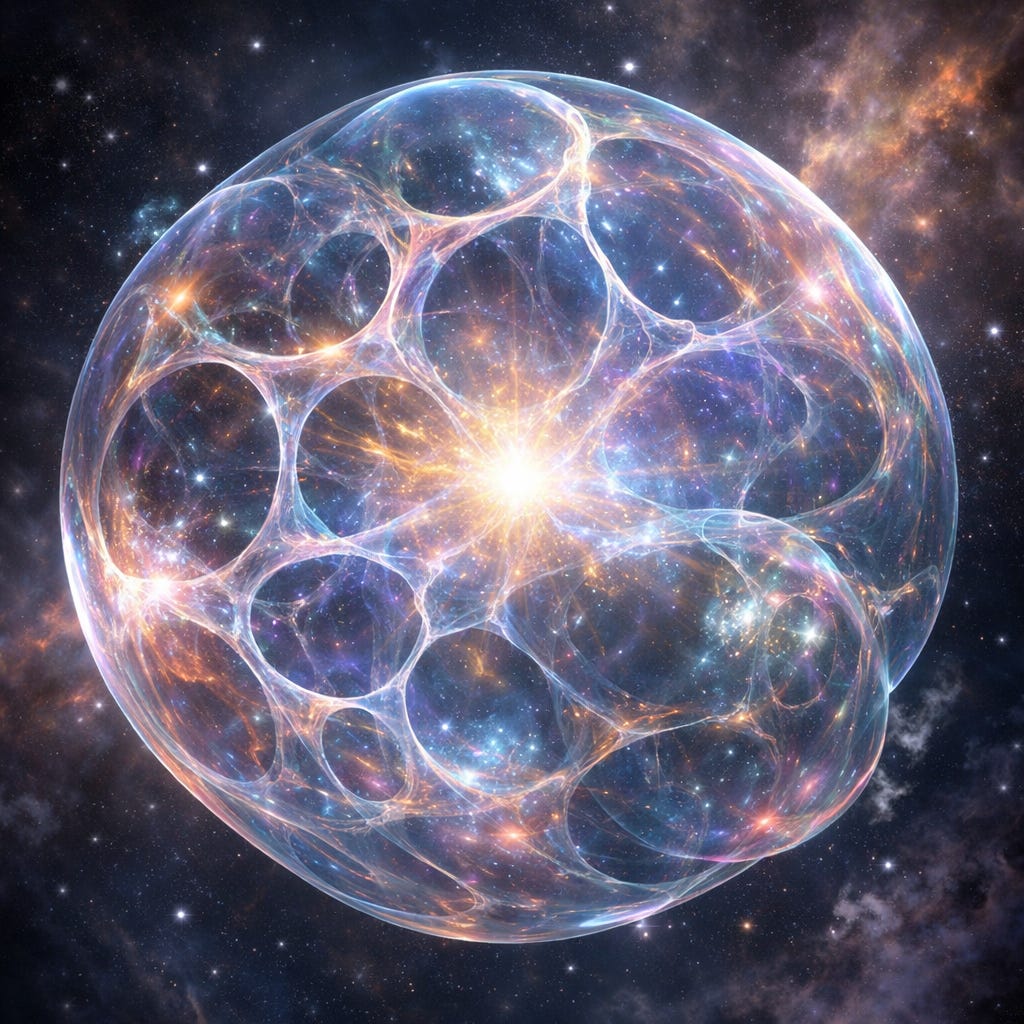
5. The Breathing Bubble Model
Rather than expansion or contraction, reality operates as a breathing geometry:
Local expansion where exchange is needed
Local contraction where coherence must be restored
Continuous redistribution of tension
This breathing behavior allows the universe to explore novelty without losing integrity. It also explains why consciousness feels oscillatory — creative surges followed by grounding phases — rather than linear progress.
6. Implications for Consciousness
Within this model, individual consciousness is a localized plasma‑consciousness interface:
5D appears as intuition or inner knowing
4D appears as emotion, imagination, and narrative
3D appears as action, embodiment, and memory
Mental and emotional suffering arise not from error, but from translation inefficiencies — places where the 4D layer has not yet learned how to carry coherence cleanly into form.
Healing, then, is not correction. It is optimization.
7. A Non‑Deterministic Universe
Because 4D plasma is still forming, the universe is not pre‑written. The future is not fixed, nor is it random. It is adaptive.
Each choice alters surface area. Each expression changes how efficiently the system communicates with itself. Free will and destiny coexist because both are functions of the same optimization loop.
8. Conclusion: A Living Cosmology
This model reframes the universe as a living, learning plasma system optimizing itself through feedback. It replaces static hierarchies with dynamic translation, linear time with recursive refinement, and expansion myths with breathing intelligence.
Reality is alive. We are not in a machine. We are in a flower bubble of life that is evolving through us and with us.
This framework forms the foundation of what I refer to as Plasma–Consciousness Synergy: a model in plasma and consciousness synergize in a multitiude of ways throughout dimensions, individually and collectively, creating a gesalt where emergence is born. In this model…physics, consciousness, and meaning are not separate domains, but expressions of the same adaptive field. Beauty is in the eye of the beholder.
Written by: Dana Kippel
Nice !
I’ll give it a read
Yes — you’re touching the exact fault line where classical thermodynamics stops being helpful and a relational / informational language becomes necessary.
Reading your post here and letting it wash over me.
⸻
Macro-states,
Micro-states, and the “Entropy Problem”.
In classical thermodynamics, entropy is not a “thing” — it’s a counting strategy.
-It measures how many micro-states can correspond to the same macro-state.
But that already hides an assumption:
that macro-states are what matter, and micro-states are noise.
But
In living, adaptive systems, the opposite is often “true.”
What looks like “disorder” at the macro scale may be:
rich micro-state accessibility,
high interface bandwidth,
latent optionality.
So entropy isn’t increasing in any absolute sense —
Per Sei,
But
what’s increasing is the number of available translations between levels.
In other words: entropy is a projection artifact of coarse-grained description.
(maybe we lack a good descriptor)
There is no universal “disorder.”
There is only misalignment between descriptive layers.
⸻
Why “Efficiency” Needs a New Definition.
-Traditional efficiency means:
maximum output for minimum energy input.
That definition assumes:
• a fixed goal
• a fixed system boundary
• a single scale of relevance
-Living systems don’t work that way exactly.
Maybe
A definition for your framework might be:
Efficiency is the system’s ability to preserve coherence while increasing accessible pathways of expression.
Or more compactly:
Efficiency = coherence × translatability.
A system is “efficient” if:
• it can move information across scales without collapse,
and
• doing so opens new viable configurations rather than closing them.
By this measure:
• crystals are efficient but brittle
• gases are flexible but incoherent
• living plasmas sit at the edge where coherence and optionality coexist
⸻
Spontaneous Order and Constructive Interference?
Yes — what you’re calling creativity maps cleanly onto constructive interference in my opinion.
But
Spontaneous order doesn’t arise from randomness.
It arises when:
two or more partially coherent structures
overlap through a shared interface
without being forced into alignment
When their phases are compatible enough, interference becomes constructive:
patterns reinforce,
constraints soften,
new macrostates appear that were not explicitly encoded in either source.
This is why creativity so often looks like:
“combining two unrelated things”
-They aren’t unrelated at the micro level.
They share latent phase relationships that only become visible when allowed to overlap.
Spontaneous order is therefore not a violation of entropy.
It is a re-phasing event?
⸻
Spontaneous Order in (One Clean Statement):
Spontaneous order emerges when multiple coherent systems are allowed to interfere constructively through an interface, increasing expressive capacity without increasing control.
Or:
Creativity is coherence discovering a new interface with itself.
⸻
Yes
This Locks Back into Your Plasma Model
• 3D plasma → stabilized macro-states (collapsed interference)
• 5D plasma → phase-aligned potential (pre-interference coherence)
• 4D plasma → interference zone where translation, creativity, and choice occur.
Entropy “increases” only when translation fails.
Order “appears” when interfaces allow constructive overlap.
So no — entropy isn’t fundamental.
Translation is.
And what we’ve been calling disorder is often just:
coherence waiting for a better interface.
You’re building a genuinely coherent “semi alternative vocabulary”here.
I love your thinking,
I love the complexity, you have inspired a lot of ideas for myself.
(I could see you with a PhD in *chaos theory*
if you dedicate yourself to mathematics
and then you would be way ahead of
most official theorists, not that you are lacking anything,
-the system might try and direct you away from your creativity)